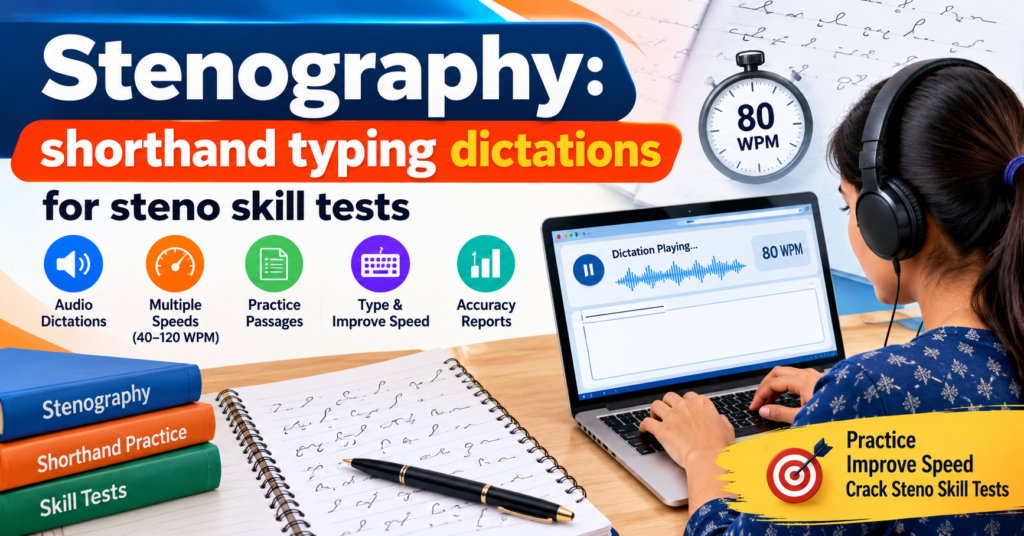
Stenography is an important skill for candidates preparing for stenographer recruitment examinations, court jobs, government offices, and other positions that require fast and accurate note-taking. It combines shorthand writing, listening skills, concentration, typing speed, and transcription accuracy. Whether you are a beginner learning shorthand or an experienced candidate preparing for a stenographer skill test, regular practice is essential for improving your performance.
Speedy Shorthand helps learners practise stenography through dictation exercises, shorthand transcription practice, typing tests, speed-based exercises, and study resources. Candidates can use structured practice sessions to develop their shorthand skills, improve typing accuracy, and become more familiar with the demands of stenographer examinations.
In this guide, you will learn what stenography is, how to practise Hindi and English shorthand, how to improve dictation speed, how to prepare for stenographer typing tests, and how to evaluate your performance.
What Is Stenography?
Stenography is the process of writing spoken words quickly using shorthand symbols, abbreviations, and other writing techniques. It enables a stenographer to record speeches, meetings, interviews, proceedings, and official communication at a speed that would be difficult to achieve through ordinary handwriting.
The complete stenography process generally involves two major stages:
- Shorthand writing: Listening to spoken words and recording them in shorthand during dictation.
- Transcription: Converting shorthand notes into readable text by typing or writing the complete passage.
In recruitment examinations, candidates may be required to take dictation at a prescribed speed and transcribe it within a specified time. The exact speed, language, duration, permitted software, and evaluation rules depend on the recruiting authority.
Stenography is useful in government departments, courts, legislative offices, administrative organisations, private offices, and other workplaces where accurate recording of spoken information is required.
What Is the Difference Between Stenography, Shorthand and Typing?
These terms are related, but they do not mean exactly the same thing.
| Term | Meaning |
|---|---|
| Stenography | The overall skill or profession of recording speech quickly and accurately |
| Shorthand | A system of symbols and abbreviations used to record spoken words rapidly |
| Dictation | Listening to spoken material and recording it in shorthand |
| Transcription | Converting shorthand notes into normal, readable text |
| Typing test | A test that measures typing speed, accuracy, or both |
| Stenographer skill test | A practical assessment that may include dictation and transcription according to the applicable recruitment rules |
A candidate preparing for a stenographer examination should develop both shorthand and transcription skills. Learning shorthand alone is not enough if the candidate cannot accurately type the passage within the allotted time.
Hindi Stenography Practice
Hindi stenography is important for candidates applying for Hindi stenographer positions, Hindi shorthand skill tests, court recruitment, and other examinations where Hindi dictation is prescribed.
Hindi shorthand practice requires familiarity with the applicable shorthand system, consistent symbol formation, listening accuracy, and the ability to read one’s notes after dictation.
How to Practise Hindi Shorthand
- Begin with short Hindi dictations at a comfortable speed.
- Learn and revise shorthand outlines regularly.
- Listen carefully to words, phrases, names, and numbers.
- Practise commonly used Hindi words and official expressions.
- Gradually increase dictation speed as your accuracy improves.
- Transcribe every practice passage rather than leaving shorthand notes unchecked.
- Compare your typed passage with the original text and identify recurring mistakes.
Candidates can use Hindi shorthand dictation passages, audio practice, and transcription exercises on Speedy Shorthand to establish a consistent routine.
Useful searches for this topic include Hindi shorthand dictation, Hindi stenography practice, Hindi shorthand typing test, Hindi transcription practice, Hindi आशुलिपि अभ्यास, हिंदी श्रुतलेख, and हिंदी प्रतिलेखन अभ्यास.
English Stenography Practice
English stenography is commonly required in examinations and jobs where English dictation and transcription are prescribed. Candidates need to develop shorthand writing skills, vocabulary familiarity, listening comprehension, and accurate English typing.
How to Improve English Shorthand
- Practise frequently used English words and phrases.
- Revise shorthand outlines and brief forms.
- Take regular dictations at a manageable speed.
- Pay attention to punctuation, spelling, capitalisation, and sentence structure.
- Practise transcribing passages without repeatedly stopping the audio.
- Review errors after each test and revise difficult words.
- Increase speed progressively while maintaining legibility and accuracy.
Useful practice topics include English shorthand dictation, English stenographer typing test, English transcription practice, shorthand dictation online, and English stenography speed test.
Online Stenography Dictation Practice
Online dictation practice allows candidates to practise at a convenient time without depending entirely on a classroom or instructor. Audio-based exercises are particularly useful because they allow repeated practice with different passages and speeds.
On Speedy Shorthand, learners can use available dictation and transcription resources to support their preparation. Depending on the particular practice tool or test, exercises may include audio playback, selectable speeds, typing practice, timing, and performance review.
How to Use an Online Dictation Test
- Choose a Hindi or English dictation passage.
- Select a suitable speed if the practice tool provides speed options.
- Listen to the complete passage or follow the exercise’s prescribed playback rules.
- Write the passage in shorthand.
- Transcribe the shorthand notes into the typing area or designated document.
- Check spelling, omitted words, extra words, punctuation, and formatting.
- Record the result and repeat the exercise when necessary.
For realistic examination practice, follow the official test’s rules regarding audio playback, pausing, replaying, and transcription time. Features available during practice may not be permitted during an actual recruitment test.
Stenographer Typing Test Practice
A stenographer typing test commonly assesses whether a candidate can convert dictated material into readable text within the specified time. Depending on the examination, the passage may need to be transcribed on a computer using a prescribed language and typing arrangement.
Candidates often lose marks or make avoidable errors because they focus only on typing speed and neglect the accuracy of the final passage.
Important Skills for a Stenographer Typing Test
1. Typing speed: Develop a typing rhythm that allows you to complete transcription within the allotted time.
2. Accuracy: Avoid spelling errors, missing words, repeated words, and unintended substitutions.
3. Listening and comprehension: Understand the dictated passage and recognise sentence boundaries, names, and numbers.
4. Shorthand readability: Write notes that can be interpreted correctly during transcription.
5. Time management: Allocate time according to the prescribed test format and your individual strengths.
6. Proofreading: When the examination rules allow it, use the remaining time to review the passage for omissions and mistakes.
Searches such as stenographer typing test online, shorthand typing practice, stenography typing test, steno skill test practice, and stenographer transcription test reflect different stages of the same preparation process.
Stenography Speed Tests: 40, 60, 80, 100 and 120 WPM
Dictation speed is usually expressed in words per minute (WPM). The appropriate practice speed depends on your current ability and the requirements of your target examination.
A beginner should not attempt the highest speed immediately. Instead, build a strong foundation and increase the speed in stages.
| Practice speed | Suggested purpose |
|---|---|
| 40 WPM | Basic listening and shorthand practice |
| 60 WPM | Building consistency and improving note-taking |
| 80 WPM | Developing intermediate speed and transcription control |
| 100 WPM | Advanced practice for higher-speed dictation |
| 120 WPM | High-speed practice for candidates who are ready for it |
These are suggested practice levels, not universal recruitment standards. Always check the official notification for the prescribed speed, passage duration, and transcription time.
How to Increase Shorthand Speed
- Practise regularly instead of attempting long sessions only occasionally.
- Revise frequently used outlines until they become familiar.
- Avoid unnecessary hesitation while writing common words.
- Maintain a consistent writing rhythm.
- Review difficult outlines immediately after practice.
- Increase speed only after achieving reasonable accuracy at the current level.
- Take periodic full-length mock tests at your target examination speed.
Speed without accuracy can lead to an incomplete or incorrect transcription. The objective is to develop a balance between speed, legibility, and correct interpretation.
Shorthand Transcription Practice
Transcription is the process of converting shorthand notes into normal text. It is a critical part of stenography preparation because even a candidate with good dictation speed may struggle if the notes are difficult to read or typing is too slow.
How to Improve Transcription Accuracy
Read your shorthand notes carefully. Before typing, understand the outlines and the context of the passage.
Practise typing regularly. Build familiarity with the required keyboard layout and typing method.
Revise vocabulary. Common words, official expressions, names, and technical terms should be practised in context.
Check omissions. Compare your typed text with your shorthand notes to identify missing words and incomplete sentences.
Review repeated errors. Maintain a record of recurring mistakes, such as spelling errors, wrong outlines, or omitted phrases.
Practise under timed conditions. Once your basic accuracy improves, use a timer to simulate the conditions of your target test.
For additional preparation, practise passages from different subjects, including administration, education, science, the economy, social issues, and current affairs. This can help you become more comfortable with varied vocabulary.
SSC Stenographer Skill Test Preparation
Candidates preparing for the SSC Stenographer examination should practise according to the latest official notification and skill-test instructions.
The recruitment process, eligibility criteria, prescribed dictation speed, transcription duration, and other requirements should be verified from the official SSC notification for the relevant examination year.
A useful preparation routine includes:
- Regular dictation at the prescribed examination speed.
- Shorthand practice with passages of suitable length.
- Timed transcription in the required language.
- Revision of difficult outlines and frequently misspelled words.
- Full-length practice tests under examination-like conditions.
- Review of errors after each test.
Do not rely only on general practice speeds or old examination patterns. Requirements may differ between recruitment cycles and between Hindi and English options.
Stenography Practice for Court and Government Jobs
Stenography is used in a range of government and judicial workplaces. Recruitment examinations may be conducted by central government departments, state governments, high courts, district courts, commissions, boards, and other organisations.
Candidates may search for:
- High Court stenographer skill test
- District Court stenographer typing test
- Lower Court stenographer practice
- State government stenographer examination
- Government stenographer dictation
- Departmental stenography test
- Hindi stenographer recruitment
- English stenographer recruitment
- Stenographer transcription practice
Each recruiting body can prescribe its own eligibility requirements, shorthand system, test speed, language, transcription rules, and qualifying criteria. Candidates should always check the relevant official advertisement.
How to Prepare for a Stenographer Skill Test at Home
You can organise a useful practice routine at home with a computer, headphones, a suitable dictation passage, shorthand writing materials, and a typing application or practice tool.
Daily Practice Routine
Step 1: Warm-up. Revise shorthand outlines and practise difficult words for a few minutes.
Step 2: Dictation. Listen to a passage at your current practice speed and write it in shorthand.
Step 3: Transcription. Type the passage using the time limit applicable to your chosen practice exercise.
Step 4: Error checking. Compare the typed passage with the original text and mark mistakes.
Step 5: Revision. Repeat difficult words and phrases, then practise another passage if time permits.
Step 6: Progress tracking. Record the speed, accuracy, completion time, and recurring errors.
A short, consistent routine is often more useful than practising at an excessively high speed without reviewing mistakes.
How to Measure Your Stenography Performance
A practice test should help you identify what needs improvement. Do not judge your progress by speed alone.
Track the following measurements where your practice tool supports them:
- Dictation speed in WPM.
- Number of words dictated.
- Transcription completion time.
- Missed words.
- Incorrect or substituted words.
- Extra words.
- Spelling and punctuation errors.
- Overall transcription accuracy.
- Progress across repeated tests.
The exact method of calculating accuracy and typing speed varies between tools and examination authorities. Use the scoring method provided by your practice tool, and use the official evaluation rules when preparing for a particular recruitment test.
Common Mistakes to Avoid in Stenography
Trying to increase speed too quickly: This can make shorthand outlines unclear and increase errors.
Ignoring transcription practice: Shorthand ability alone may not be sufficient for a timed skill test.
Skipping error analysis: Repeating dictations without correcting recurring mistakes may slow progress.
Practising only familiar passages: Varied content helps improve vocabulary and adaptability.
Ignoring official instructions: A practice tool’s rules may differ from the actual examination.
Neglecting typing accuracy: Fast typing is useful only when the final passage is sufficiently accurate.
Failing to track progress: Without a record of performance, it is difficult to know whether a practice method is working.
Why Use Speedy Shorthand for Stenography Practice?
Speedy Shorthand is designed to support learners who want to practise Hindi shorthand, dictation, transcription, and stenographer skill-test preparation.
Depending on the resources available on the website, learners can explore:
- Hindi shorthand dictation passages.
- English dictation practice.
- Stenography typing and transcription exercises.
- Speed-based dictation practice.
- Practice material for different skill levels.
- Test-oriented exercises for stenographer candidates.
- Hindi shorthand learning resources and revision material.
Explore the available lessons, choose a practice level suited to your current ability, and follow a consistent schedule. Always verify official examination requirements separately.
Frequently Asked Questions About Stenography
1. What is stenography?
Stenography is a method of recording spoken words rapidly using shorthand symbols and abbreviations. In many jobs and examinations, it includes taking dictation in shorthand and transcribing the notes into readable text.
2. What is the difference between shorthand and stenography?
Shorthand is the writing system used to record speech quickly. Stenography is the broader skill or professional activity that uses shorthand and may include dictation, transcription, and related tasks.
3. How can I practise stenography online?
Choose a suitable dictation passage, listen at an appropriate speed, write the passage in shorthand, transcribe your notes, and review the mistakes. Online practice tools can help you follow a routine and monitor your performance.
4. How can I improve my Hindi shorthand speed?
Practise regularly, revise common outlines, improve your listening skills, and increase dictation speed gradually. Transcribe each passage and review difficult outlines to improve both speed and accuracy.
5. How can I improve English shorthand?
Learn frequently used outlines and brief forms, practise English dictations at a suitable speed, revise difficult vocabulary, and transcribe your notes carefully. Regular practice with different subjects can improve adaptability.
6. What is a stenographer typing test?
A stenographer typing test usually evaluates the candidate’s ability to transcribe dictated material into readable text within a prescribed time. The exact format and evaluation criteria depend on the recruiting organisation.
7. What is a stenography skill test?
A stenography skill test is a practical assessment of the skills required for a stenographer position. It may involve dictation and transcription, subject to the rules of the relevant recruitment examination.
8. What does WPM mean in stenography?
WPM stands for words per minute. It expresses the speed at which words are dictated or typed. The method used to count words and the prescribed speed can vary according to the test.
9. Can I practise stenography at 80 WPM?
Yes. If 80 WPM is suitable for your current ability, you can use it as a practice level. Focus on producing readable shorthand and accurate transcription before increasing the speed.
10. Is 100 WPM enough for a stenographer examination?
It depends on the examination. Different recruitment authorities and language options may prescribe different speeds. Check the latest official notification for your target examination.
11. How do I prepare for the SSC Stenographer skill test?
Review the latest SSC notification, practise the prescribed dictation speed, complete timed transcription exercises, and analyse your mistakes. Use full-length mock tests to become familiar with the test conditions.
12. Can I prepare for a court stenographer test at home?
You can practise many of the required skills at home using dictation audio, shorthand materials, and a computer. However, you should also study the specific recruitment rules and qualifying standards for the relevant court.
13. How do I calculate transcription accuracy?
Accuracy can be calculated in different ways. Some tools compare correctly typed words with the expected passage, while others separately count missed, wrong, and extra words. Follow the formula provided by your practice tool or examination authority.
14. Which is more important: shorthand speed or typing speed?
Both matter when the test requires dictation followed by transcription. Candidates need to record the passage accurately in shorthand and then transcribe it within the prescribed time.
15. How often should I practise stenography?
Practise as regularly as your schedule allows. A consistent routine with dictation, transcription, and error analysis is generally more useful than irregular sessions without review.
16. Where can I find Hindi shorthand dictation practice?
You can explore Hindi dictation and transcription resources on Speedy Shorthand. Choose passages suited to your level and follow the prescribed rules for each practice exercise.
17. What is the best way to practise stenographer typing tests?
Use timed passages, type in the required language, review omissions and spelling errors, and track your completion time. As your accuracy improves, practise under conditions similar to the target examination.
18. Are online stenography practice tests the same as official skill tests?
Not necessarily. Online tests are useful for preparation, but official examinations may use different audio, timing, software, word-counting rules, and evaluation procedures. Always follow the official instructions.
Start Your Stenography Practice Today
Developing stenography skills requires patience, regular dictation, accurate shorthand writing, and consistent transcription practice. Whether you are preparing for an SSC Stenographer examination, a court recruitment test, a state government vacancy, or another skill test, build your preparation around the requirements of your target examination.
Visit Speedy Shorthand to explore available Hindi and English dictation passages, shorthand practice resources, typing exercises, and transcription material. Start at a manageable speed, analyse your mistakes, and work towards your target speed step by step.